Two encouraging numbers can sound like two confirmations of the same experience. Before drawing that conclusion, ask what was measured and whether the observations belong together. A judgment about improvement, a record of an event and a broader goal are different pieces of information. Their relationship is a question to investigate, not something a shared positive direction automatically settles.
This article uses the sildenafil research below as a starting point for original methodological analysis. The chart presents a reported study result; the worked examples are deliberately invented arithmetic. We examine what an analyst would need to connect different measurements, how identical totals can hide different patterns, and why careful language about agreement helps a reader form a useful question. No fictional example reconstructs trial participants.
A result in context
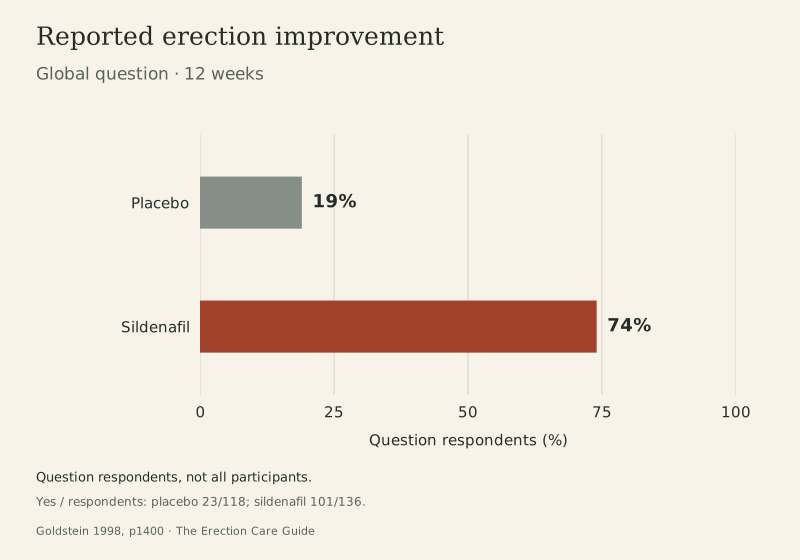
| Group | Percent | Yes / respondents |
|---|---|---|
| Placebo | 19% | 23 / 118 |
| Sildenafil | 74% | 101 / 136 |
Erection improvement after 12 weeks; question respondents only.
Not intercourse-attempt success or overall sexual health. No error bars.
1A shared direction leaves another question open
Goldstein’s 1998 report includes a 329-man randomized trial of oral sildenafil versus placebo. It measured an overall improvement judgment and intercourse diaries. Pfizer supported the research; investigator consulting relationships were reported.
Consider two hypothetical measures that both favor a treatment group. That pattern can support a discussion of the group comparisons. It still leaves open a separate question: did the same people have favorable results on both measures? The first statement compares groups. The second asks how measurements fit together inside a group. Moving between them requires information that the separate totals do not contain.
Think of a spreadsheet with one outcome on each of two tabs. If the tabs contain only totals, their relationship cannot be restored by placing them side by side. An analyst needs a legitimate way to match observations, compatible definitions and an appropriate observation period. This is why a reader should preserve the exact question behind a result before combining it with another. Our guide to reporting treatment response offers a practical place to organize distinct observations without deciding in advance that they share one cause.
1Build a paired record before asking about agreement
For an original thought experiment, imagine ten anonymous records, each with two fictional yes-or-no measurements called A and B. These letters do not stand for a named trial instrument. A paired record keeps both answers on the same row. Once that pairing exists, every record belongs in one of four boxes: yes to both, yes only to A, yes only to B, or no to both.
That arrangement supplies information a pair of headline percentages lacks. It reveals overlap and disagreement directly. It also forces the analyst to say whether both questions were answered, whether they cover a compatible period, and what happens to a row with an unavailable answer. A blank is a separate data condition; quietly treating it as no would change the question being analyzed.
Pairing should remain a description of how records are organized, not a claim that two questions are equally good. A beautifully aligned spreadsheet can still contain ambiguous questions. Nor does pairing prove causation. It makes a particular descriptive calculation possible. Deciding why the observations coincide would require additional reasoning and evidence beyond the act of matching rows.
1Identical totals can conceal opposite overlap patterns
The two invented arrangements in the table each contain ten records. In each arrangement, six answers are yes on A and six are yes on B. Someone reading only the margins would therefore see the same two totals. Yet the arrangements describe very different relationships between the answers. The table is a mathematical demonstration, not a simulation of the sildenafil study.
In arrangement One, every A-positive record is also B-positive. Six rows say yes twice and four say no twice. In arrangement Two, only two rows say yes twice; the other eight split evenly between the two kinds of disagreement. The matching margins have concealed a change from ten agreeing rows to two. Nothing about those margins tells the reader which arrangement occurred.
This is a useful way to challenge an inference without disputing either reported total. The problem is missing relational information, not necessarily an incorrect number. If a claim concerns the same people experiencing two outcomes, ask for paired results or an analysis that actually addresses overlap. A group-level summary can be valid while being insufficient for that additional claim.
| Paired answers | Arrangement One | Arrangement Two |
|---|---|---|
| Yes on A and B | 6 | 2 |
| Yes only on A | 0 | 4 |
| Yes only on B | 0 | 4 |
| No on either measure | 4 | 0 |
An event log and a person-level answer need a bridge
A second original example changes the unit of observation. Suppose one fictional person contributes two event records and another contributes eight. A table with ten event rows is not a table with ten people. Before comparing it with one answer per person, an analyst must decide how to summarize events for each individual and what that summary is intended to mean.
Possible summaries answer different questions. Counting favorable events describes frequency. Dividing favorable events by recorded opportunities describes a proportion. Recording whether any favorable event occurred creates a yes-or-no measure. These transformations can all be calculated from suitable records, but none is a neutral replacement for the others. The selected rule changes the information retained and the people who can contribute to the calculation.
A person with no recorded opportunity illustrates the difficulty. An event proportion may be undefined rather than zero, while a broader judgment might still be available. The appropriate response is to specify the rule, not invent an event. Our companion analysis of choosing an outcome develops the related question of deciding what to measure before selecting a result.
14Agreement requires compatible questions, not identical wording
Two measurements can agree numerically while addressing different ideas. In an original reading exercise, one question might ask whether an event occurred and another whether the experience met a personal expectation. The first is about an occurrence; the second includes a standard of comparison. Equal percentages would not erase that distinction, and unequal percentages would not automatically expose an error.
Start by writing a plain-language definition of each measurement. Then ask which aspects overlap, which are exclusive to one question, and which matter to the reader but appear in neither. This is a question of coverage: the range of experience a measure is designed to represent. Coverage is different from precision. A very precise answer to a narrow question can leave a broad concern largely untouched.
For example, confidence, comfort and satisfaction could be separate questions in a hypothetical research plan. Naming them does not establish that any particular trial measured them or that one medicine changes them. It identifies additional evidence that would be needed for a broader claim. The guide to care beyond tablets can help frame that broader conversation without converting a trial endpoint into a complete account of sexual health.
1Disagreement is a finding to describe before explaining
If two compatible measurements disagree, the next step is to describe the pattern carefully. Which kind of disagreement occurs? Does one question consistently receive a more favorable answer, or do mismatches go in both directions? Are they concentrated in a particular situation? These are questions for appropriate records; the presence of disagreement alone does not provide their answers.
An original checklist can separate possible explanations from established ones. Differences might reflect question scope, the period a person considers, the opportunities recorded or how an answer is interpreted. Listing possibilities is not a diagnosis. To choose among them, an analyst would need evidence that discriminates between the explanations rather than simply repeating that the measures differ.
This distinction also improves an ordinary consultation note. A reader can describe two observations without forcing them into a single success-or-failure label. The goal is to preserve useful detail for the clinician, not to administer a research instrument independently or assign a cause. Our first-visit preparation guide provides a structure for bringing the concern, context and medication list to that discussion.
12Repeatability, agreement and importance answer different questions
Imagine an original measurement exercise in which the same question is repeated under genuinely comparable conditions. Similar answers would address repeatability. Now compare two different questions answered at one time: their relationship addresses agreement or association, depending on the measurements. Finally ask whether a change matters to the person. That introduces importance. These are three separate questions, even when the same dataset contributes to each.
A repeatable answer can remain narrowly focused. Two measures can move together without measuring exactly the same thing. A small numerical change can have different practical meanings depending on what the number represents. Conversely, a large-looking change on an unfamiliar scale cannot explain its own significance. The analyst needs definitions, measurement properties and an appropriate interpretation rather than relying on the visual size of a number.
For a reader, the useful habit is to finish the sentence after the word improved. Improved on which measure, compared with what, and with what relevance to the concern? This keeps the evidence claim specific. It also leaves room for a clinician to explain how a research measurement relates to a person's assessment, without asking a published average to substitute for that assessment.
1A new reporter adds a perspective, not an automatic verdict
Suppose an original research proposal adds a second person's account of an experience. Before comparing answers, the proposal would need to define what each reporter can observe and what each is being asked to judge. A report about one's own sensation and a report about an observable event do not have identical access to information. Disagreement may therefore be informative without identifying one answer as false.
A sound comparison would also consider independence. If one reporter sees the other's answer before responding, the resulting agreement has a different interpretation from separately collected answers. This is a design question, not an assertion about the conduct of the historical trial. The point is to specify the conditions that make the proposed comparison interpretable.
The table outlines questions an analyst could ask before combining measurements. It is an editorial planning aid, not a validated questionnaire or a scoring system. Its value lies in slowing down the move from two numbers to one conclusion. Each row names a requirement that can be checked; none supplies an answer on behalf of a patient, partner or research participant.
| Question to settle | What to document | What it prevents |
|---|---|---|
| Do the rows match? | A defined pairing rule | Assuming totals reveal overlap |
| Do the questions align? | Meaning, unit and observation period | Treating different concepts as duplicates |
| Were answers independent? | How each report was collected | Mistaking shared information for independent agreement |
| What remains outside scope? | Unmeasured concerns and unresolved questions | Turning a narrow result into a complete verdict |
Keep efficacy interpretation separate from safety decisions
Current Viagra labeling lists headache, flushing and indigestion among adverse reactions. Nitrates and riociguat are contraindicated; safe nitrate timing is not established even after 24 hours. An erection lasting over four hours requires emergency care. Sudden vision or hearing loss calls for stopping the medicine and prompt medical help. Cardiovascular status and interacting medicines require clinical review. These label facts are separate from the arithmetic examples above.
The distinction matters because a favorable outcome and an acceptable treatment choice are not the same proposition. One describes a measurement; the other requires consideration of a person's circumstances and the actual prescription. No amount of agreement between efficacy measures removes an interaction or turns an adverse symptom into something to score later. Research interpretation should improve the quality of questions, not create a self-prescribing rule.
When comparing medicine descriptions, keep the product and schedule explicit. Our sildenafil and tadalafil guide supplies questions to discuss with a clinician. The current Cialis label is a separate prescribing source, not a reason to transfer sildenafil findings to another regimen. Do not combine ED medicines on the basis of a chart or a favorable response.
25Carry the measurement question into a product review
The FDA states that compounded drugs are not FDA-approved and do not undergo its premarket review of safety, effectiveness and quality. They can address medical needs, but quality failures can cause serious harm. Those regulatory facts identify another question to keep separate from the meaning of a research endpoint: what evidence concerns the finished product actually being considered?
As editorial reasoning, a trial result and a service description should occupy different columns in a reader's notes. One column records the research question and measured outcome. The other records the named formulation, available documentation and terms requiring confirmation. An ingredient name appearing in both columns does not fill the evidentiary space between them. Our compounded-product guide explains the questions to preserve at that boundary.
For documentary context, the Ro Sildenafil review and Hims Sildenafil review provide places to inspect recorded product information and terms. These links do not establish trial equivalence, current availability or provider outcomes. A useful final note states exactly which question the research addresses, which question the product documents address, and what still needs a qualified answer.
32Questions about the evidence
Do two positive group results prove the same people improved twice?
No. The fictional paired-record example shows why identical totals can describe different overlap patterns. To answer a same-person question, an analyst needs appropriately paired observations and compatible definitions. This is a mathematical limit of separate totals, not a claim that either individual result is wrong or that the underlying treatment has no effect.
1Should I calculate an agreement score from the published percentages?
Separate percentages do not supply the paired cells needed for that calculation. Even with paired records, choosing an agreement measure would require attention to the kind of data and the scientific question. The practical reading step is to identify what information is available and what additional relationship the proposed calculation would claim to describe.
1Does a mismatch mean one answer is unreliable?
A mismatch alone cannot settle that. The questions may cover different concepts, periods or observations. First define the difference and identify what each answer represents. Evidence about repeatability or measurement error would address a further question. Calling an answer unreliable without that work would add an explanation that the mismatch itself does not provide.
1Can a broader personal goal be added to a consultation note?
Yes: as an ordinary description of the concern, not as a replacement research endpoint. State what matters, what was observed and what remains uncertain. Keeping these elements separate helps avoid forcing every experience into one score. A clinician can then discuss the concern in the context of the person's assessment and actual treatment.
2What should a review say when it links a product to research?
It should distinguish the studied intervention and outcome from the named product and its documentation. A link is a route to information, not evidence that a provider reproduces a trial result. Readers should be able to see which statements are research findings, which are recorded commercial terms and which are the publication's interpretation.
32What this means for a reader
The strongest reading habit here is to preserve the relationship a claim requires. A group comparison needs a comparator. A claim about two outcomes in the same people needs paired information. A claim about broader wellbeing needs measurements that actually address it. Treat those as different evidentiary tasks. The chart provides one defined result; the original examples explain why additional conclusions need additional information. A careful reader can recognize a useful finding while still asking a precise next question.
Evidence access
Full paper retained October 23, reread October 24; fresh download blocked. Protocols, supplements and individual records were not reviewed.
Sources for this page
Scientific sources have their own checked dates below. Existing provider and medical records retain their earlier checks. Company pages support descriptions of advertised offers, not independent claims of clinical quality.
- Goldstein 1998Primary research · Checked 2026-10-24
- Viagra prescribing informationOfficial prescribing information · Checked 2026-10-24
- FDA: compounded drugsFDA guidance · Checked 2026-10-24
- Porst 2006Study · Checked 2026-10-24
- Cialis prescribing informationOfficial prescribing information · Checked 2026-10-24