A research report can offer several ways to describe improvement. The largest number may be easy to remember, but choosing it first can leave the original question behind. A more informative reading begins with the concern, identifies the measurement intended to address it, and only then considers the result. That order makes it easier to explain what the evidence adds.
The tadalafil chart below supplies a specific reported endpoint. The rest of this article develops an original method for reading outcome choices: how to distinguish priorities from categories, why several related measurements are not independent votes, and what a broader claim would require. The fictional examples demonstrate reasoning rather than reconstructing the trial or alleging that its investigators changed their plan.
A result in context
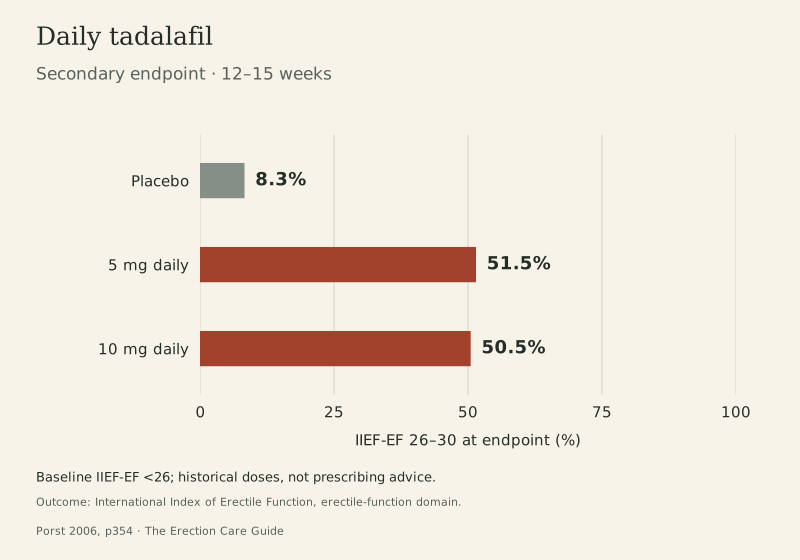
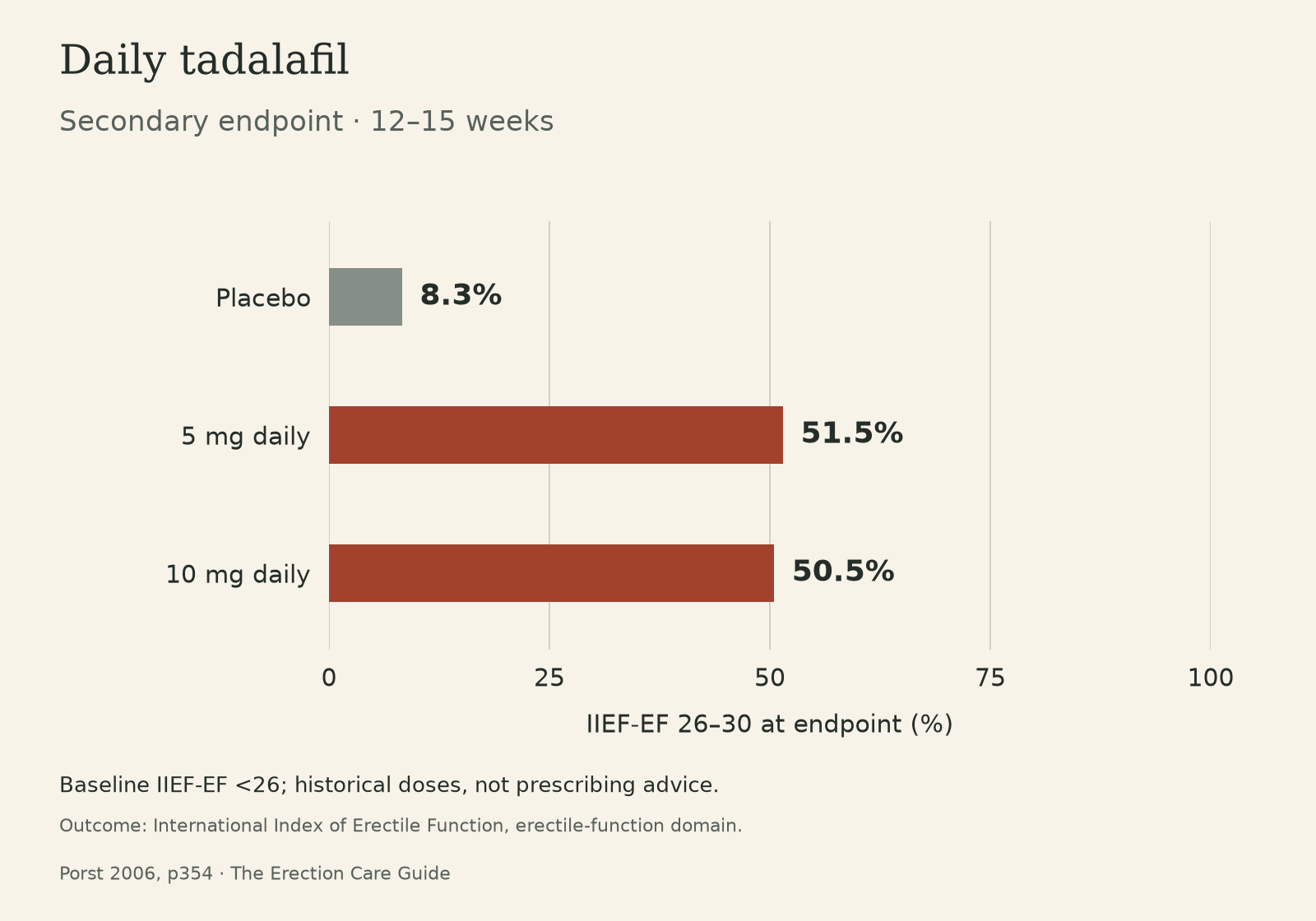
| Group | Percent |
|---|---|
| Placebo | 8.3% |
| 5 mg daily | 51.5% |
| 10 mg daily | 50.5% |
Tadalafil: baseline IIEF-EF <26; endpoint 26–30.
Secondary; historical doses, not prescribing advice.
1Write the claim before opening the results column
Porst’s randomized trial compared daily tadalafil with placebo in 268 men with ED over 12–15 weeks, separating primary and secondary outcomes. Lilly ICOS provided funding; company staff provided statistical/writing support.
An original way to read such a report is to draft the intended claim as a sentence with blanks: in this population, this intervention changed this measurement over this period compared with this alternative. Filling those blanks before selecting a number makes hidden substitutions easier to detect. It prevents a result about one measurement from quietly becoming a claim about every aspect of the condition.
The chart's title, unit and eligibility note belong to the result, not to optional fine print. A number separated from those definitions becomes easier to reuse for a different question. Preserve them together when taking notes. Our guide to describing treatment response offers a practical parallel: describe the observation before deciding what it proves. A clear account can include an unanswered question; it does not need to compress every concern into one favorable or unfavorable label.
1Give each measurement a job
Imagine an original research planning meeting with five possible questions. One concerns whether an event occurred. Another asks for a person's overall judgment. A third concerns movement on a scale. A fourth asks whether a defined boundary was crossed. The fifth concerns a broader experience of wellbeing. These questions may relate to one another, but none is simply a longer name for all the others.
Assigning a job to a measurement clarifies what an answer would establish. An event record addresses that event under the stated recording rules. A boundary creates categories from a scale. A broader question requires its own definition and method. The distinction helps identify which additional evidence is needed without dismissing a narrower measure for failing to answer a question it was never assigned.
The table is an editorial planning aid, not a description of a study's complete outcome list. Use it to test the match between a proposed claim and its evidence. If the claim changes while the measurement stays the same, pause and explain the connection. An attractive result cannot supply that connection merely by looking large.
| Question type | What the measure describes | Additional claim requiring more evidence |
|---|---|---|
| Event | A defined occurrence | The whole experience was satisfactory |
| Overall judgment | A specified personal appraisal | Every component improved |
| Scale change | Movement under a scoring rule | A particular category was reached |
| Threshold | Crossing a defined boundary | Every relevant concern resolved |
| Broader wellbeing | The aspects explicitly assessed | Unmeasured aspects also improved |
Priority is different from importance to an individual
A research plan needs an order for evaluating its questions. The main question helps organize design and interpretation; additional questions can supply context, explore other dimensions or examine a narrower feature. Giving a measurement a supporting role does not make it meaningless. It identifies the role it should play in the argument rather than permitting it to silently replace the main question.
A person's priorities may be organized differently. In a hypothetical consultation, a concern that occupies little space in a research report might dominate the conversation. Recognizing that difference does not invalidate the study or make the personal concern unscientific. It shows that the research and the consultation are solving related but distinct problems. The appropriate response is to identify the missing connection and discuss what evidence or assessment could address it.
Our guide to preparing for an ED visit can help keep the concern visible. As an editorial reading rule, write down the question that matters before browsing endpoint summaries. Then label each result as a direct answer, partial context or an unresolved connection. This is more informative than ranking measurements by how reassuring their numbers appear.
12A favorable-looking result can depend on the question selected
Consider a wholly fictional project with three prespecified measurements, labeled A, B and C. Suppose the invented results are ten, two and seven units of change, respectively. These are arbitrary units on different fictional scales; the numbers cannot be compared as if they shared a common ruler. The example concerns selection logic, not treatment effectiveness or a clinical benchmark.
One reading approach chooses A because ten is the largest displayed number, then builds the explanation around it. Another starts with the project's intended question and asks which measurement was designed to answer that question. Even if both approaches eventually discuss A, their reasoning differs. The first lets the appearance of the result choose the question; the second evaluates a result against a question already stated.
The table keeps the invented project constant while changing the reading strategy. It does not accuse the tadalafil investigators of selective reporting. Its purpose is to show a choice a reader can make while interpreting any multi-outcome report. A defensible summary should explain why a result is relevant, rather than relying on its position as the largest or most favorable-looking entry.
| Reading strategy | Selection rule | What remains to justify |
|---|---|---|
| Largest-number first | Choose A because 10 exceeds 7 and 2 | Whether the units and question are comparable |
| Question first | Choose the measure assigned to the stated concern | Whether its result supports the proposed claim |
| Whole-pattern review | Explain all relevant measures and their roles | How differences affect the interpretation |
Related outcomes are not independent votes
Imagine several fictional questions that share some wording, observations or underlying components. A change affecting a shared component could influence more than one answer. Seeing a similar pattern across those answers may be useful, but counting each as if it came from an unrelated experiment would give the pattern a misleading form of independence.
This is a structural point, not a calculation of the correlation between the trial's outcomes. To make a quantitative statement about dependence, an analyst would need the appropriate joint data and methods. A reader can still ask the preliminary question: what information do these measures share, and what genuinely new information does each contribute? That separates breadth of description from independent replication.
The distinction becomes especially useful when a summary presents several favorable findings in a list. The list may describe different views of a result without constituting several separate tests of the whole claim. Our companion sildenafil article examines the related problem of agreement within individuals. Together, the two questions encourage a more exact description of what multiple measurements add.
14Statistical safeguards and meaningful questions solve different problems
When a project asks many questions, its analysis plan must consider how the testing strategy affects the interpretation of apparent findings. That statistical problem is distinct from deciding whether a question matters. A method that addresses multiple comparisons does not, by itself, establish that a measurement covers the reader's concern or that the size of a change is clinically important.
For an original analogy, imagine proofreading a set of carefully numbered questions. Correct numbering helps prevent one kind of mistake, but it does not make the questions relevant or clear. In research, sound statistical procedures and sound measurement definitions are both valuable. One cannot replace the other. A reader should ask what problem a particular method addresses rather than treating the presence of a technical term as a universal guarantee.
This also limits what can be inferred from a brief methods description. To assess an entire family of analyses, an analyst would need to identify that family and the actual decision rules applied to it. A named procedure for some comparisons should not be silently extended to every possible claim. The sensible conclusion is specific: describe the scope that is documented, and leave broader coverage unasserted.
1Eligibility is part of the endpoint itself
A threshold question can have an eligibility rule different from a question about average movement. In an original example, a project asks how many records moved from below a boundary to at or above it. A record already above the boundary at the start cannot represent that crossing. Including it would change the denominator and potentially the meaning of the reported proportion.
This is why the phrase who counts belongs beside the phrase what counts. Before comparing two percentages, identify the qualifying observations for each. The same study population can produce different eligible sets for different questions. Their percentages are not made directly interchangeable simply because both use a percent sign or appear on the same page.
A useful note preserves the eligibility rule in words, especially when individual counts are unavailable. Do not invent a count by multiplying a rounded percentage by a convenient total. That shortcut could combine an approximate value with the wrong population. The point is not to produce extra arithmetic; it is to keep the original question intact while deciding whether a comparison is meaningful.
1A protocol would answer some questions, not every question
A protocol can help an analyst investigate which questions and decision rules were specified before the results were known. In an original audit plan, one would compare the dated plan with the final report, identify amendments and examine their timing and explanations. That exercise requires the actual records. A general expectation about what a protocol should contain is not evidence of what a particular protocol says.
Even a complete planning record would not settle every interpretive issue. A prespecified measurement can still be narrow, difficult to interpret for an individual or imperfectly aligned with a broader concern. Conversely, an explicitly exploratory analysis can generate a useful question without carrying the same role as the planned main analysis. The task is to label the role accurately rather than place all analyses into a simple trustworthy-or-useless divide.
For a public-facing summary, this means distinguishing a documented result, an editorial interpretation and a proposed next question. The access note below states the material reviewed for this article. It should not be read as a claim that every underlying research record was available. The analysis remains useful when its evidentiary boundary is visible.
1Safety is a separate outcome question with immediate consequences
Current Cialis labeling distinguishes routine daily ED doses of 2.5 or 5 mg from the historical 10 mg research arm. Nitrates and riociguat are contraindicated. Nitrates may be considered only for a medically necessary life-threatening situation at least 48 hours after the last dose, under close medical supervision and monitoring. That exception is not permission for home use. Headache, indigestion, back pain and muscle pain are among reported adverse reactions.
An erection lasting over four hours requires emergency care. Sudden vision or hearing loss means stopping the medicine and obtaining prompt medical help. Cardiovascular conditions, other medicines and kidney or liver impairment require clinical assessment. These current label points address a different task from deciding which efficacy measurement best fits a research question.
As editorial reasoning, a treatment choice cannot be reduced to selecting a favorable endpoint. An appropriate clinical discussion must address both the intended benefit and the relevant safety context. The sildenafil and tadalafil guide helps organize questions about medicine identity and schedules. It is a discussion aid, not a way to choose a personal dose from historical study arms or combine prescriptions independently.
25Keep the research question visible when reading an offer
The FDA explains that compounded medicines are not FDA-approved and are not reviewed by the agency for safety, effectiveness and quality before marketing. Compounding can meet medical needs; failures in quality can cause serious harm. Those facts establish a regulatory distinction, not a numerical estimate of any particular product's performance.
Our editorial approach is to keep the evidence question and the commercial question on separate lines. For the evidence question, record the population, intervention, measurement and remaining uncertainty. For the commercial question, record the exact product description, the terms that are documented and what requires confirmation. This avoids using a scientific chart as a substitute for either a product-specific evidence review or a complete treatment quote.
The Ro Daily Tadalafil review and Hims Tadalafil review are documentary starting points, not proof that a service reproduces the study. Readers can also use the ED cost worksheet and online-care comparison to organize practical questions. Keeping those tasks distinct lets a research result contribute useful context without being asked to certify a provider, a formulation or a personal outcome.
32Questions about the evidence
Is a secondary outcome automatically unimportant?
No. Its supporting role and its relevance to a particular question are separate issues. A secondary measurement may add useful context or describe a defined feature. A summary should explain that role and the measurement's scope, rather than promote it into a complete definition of recovery or dismiss it because it was not the main outcome.
1Can I compare percentages from different endpoints directly?
First check what each percentage counts and who is eligible to contribute. A shared percent sign does not establish a shared denominator, observation rule or concept. If those definitions differ, explain the difference before interpreting the numbers. Sometimes the most useful comparison is a description of the questions, rather than subtraction of the values.
1Does a statistical adjustment prove every reported claim is secure?
No single label for a method establishes its scope. The analyst needs to identify the comparisons it covered and the claim being evaluated. Statistical control, measurement relevance and clinical importance are different questions. Careful interpretation asks each in turn instead of using one technical detail as a certificate for the entire report.
1What if my concern is broader than the chart?
Describe that concern explicitly and ask what assessment or evidence could address it. A narrower measurement can remain informative without settling the broader issue. The useful connection is a clear explanation of relevance, not an assumption that improvement on one scale represents every aspect of sexual health or personal wellbeing.
12Does selecting the right endpoint select the right prescription?
No. Reading a research question accurately improves the discussion, but an individual prescription also depends on clinical assessment, contraindications, interactions and the actual product. Do not use the chart as a dosing guide or an instruction to combine treatments. Bring the evidence question and the medication question to a qualified clinician separately.
25What this means for a reader
A useful result keeps its question attached. Begin with the concern, identify the measurement and its role, preserve the eligible population, and explain the contribution of related outcomes. Then distinguish the documented finding from the broader interpretation a reader would like to make. This approach does not require choosing a single headline number to stand for the whole report. It makes the remaining questions easier to name and helps research inform a clinical conversation without pretending to complete it.
Evidence access
Full paper retained October 23, reread October 24; fresh download blocked. Protocols, supplements and individual records were not reviewed.
Sources for this page
Scientific sources have their own checked dates below. Existing provider and medical records retain their earlier checks. Company pages support descriptions of advertised offers, not independent claims of clinical quality.
- Porst 2006Study · Checked 2026-10-24
- Cialis prescribing informationOfficial prescribing information · Checked 2026-10-24
- FDA: compounded drugsFDA guidance · Checked 2026-10-24
- Goldstein 1998Primary research · Checked 2026-10-24
- Viagra prescribing informationOfficial prescribing information · Checked 2026-10-24